Lifting the Twin I Beam Suspension on 2WD F250 F350 Trucks
This is a detailed, practical, and comprehensive write‑up for leveling or lifting 2WD F250/F350 trucks. This page is a reliable reference for owners and shoppers who want to level or lift their 2WD truck.
Overview and Important Baseline
This page applies to 2WD F250/F350 models for 2017, 2018, 2019, 2020, 2021, 2022, 2023, 2024, 2025, and 2026 years.
Terminology: Level and lift are used interchangeably here. A lift often includes rear blocks; this guide focuses on the front Twin I Beam geometry and what matters for 2WD trucks.
2WD Suspension Layout
Key point: 2WD F250/F350 trucks use a Twin I Beam front suspension. Important components include the I beam, radius arm, coil spring, shock, and mounting brackets.
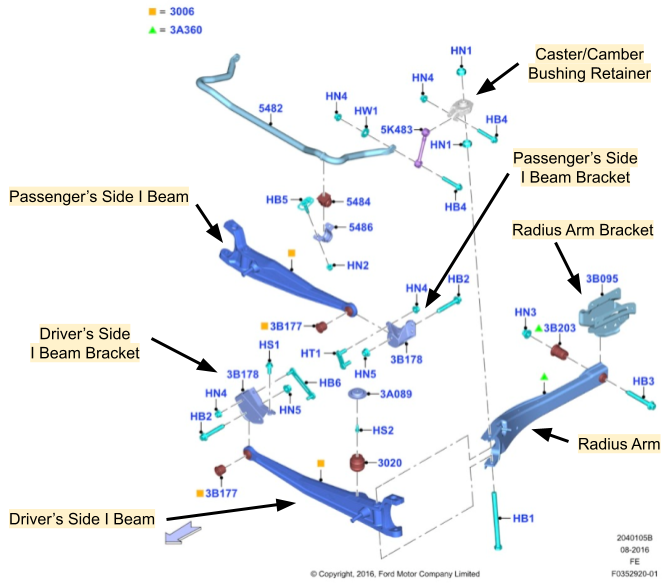
Missing from the figure:
- Coil springs (bottom of coil spring bolts to HB1)
- Shock (bolts to the radius arm)
How a level or lift changes geometry
- Lift mechanism: Increasing the coil spring effective length raises the vehicle.
- Camber change: The I beam pivot causes more positive camber. This often cannot be corrected fully without aftermarket I Beam Drop Brackets.
- Excess positive camber shifts load to the outside edge of the tire, increasing wear and reducing lateral grip; steering feels twitchy in turns.
- Caster change: The radius arm pivots lower, reducing positive caster.
- Reduced caster makes steering feel lighter and less self‑centering; you’ll need more micro‑corrections at highway speeds.
Result: Too much positive camber and too little caster after a level/lift if you don’t install the proper components. Camber is the larger safety and tire‑wear issue. Do not grind spindle material for clearance – fix the geometry instead.
All Parts for 2WD Level or Lift
Below are the required and optional parts, why they matter, installation notes, and common compatibility questions.
REQUIRED = essential for safe geometry and proper alignment.
OPTIONAL = helpful depending on lift height or preference.
Coil Spacer Set [REQUIRED]
Purpose: Creates the physical front lift. Spacer height does not equal ride‑height one‑to‑one because of Twin I beam geometry.
Common Q&A:
- Can I use a 4WD coil spacer?
- No. 2WD spacers must sit on the lower side of the coil with a threaded rod extension specific to 2WD.
- Can I buy extended coils?
- No. 2WD coils differ from 4WD coils (top retainers and coil ends). Using 4WD coils requires modifying the top tang — not recommended.
4WD Compatible: No. 4WD coils use different upper retainers.
Sway Bar Relocation Drop Brackets OR Extended End Links [REQUIRED]
Purpose: Preserves sway bar geometry after the lift to keep handling and roll control predictable.
Options:
- Drop Brackets: Lower sway bar mounts to match new height; cheaper and reliable.
- Extended End Links: More expensive; may offer better articulation for heavy off‑road use.
4WD Compatible: Yes
Shock Extension Brackets [REQUIRED]
Purpose: Prevent shocks from topping or bottoming out and preserve travel. Mount between shock eye and radius arm.
Common Q&A:
- Can I use 4WD shocks? No. 4WD shocks differ in length and travel; aftermarket lift shocks for 4WD may not fit 2WD correctly.
4WD Compatible: No. 2WD radius arms use a different lower mount (M16 stud) and top shock mounting geometry; some advertised “2WD” extenders are incompatible.
I Beam Bracket Set [REQUIRED]
Purpose: Drops the I beam pivot point to preserve OEM camber. Avoids grinding the spindle and keeps tire wear and steering geometry within alignment specs.
Common Q&A:
- What lift needs these? 2″ and above. A 1″ level may not push camber past spec, but beyond ~2″ many owners need brackets to hit alignment specs.
4WD Compatible: No. 4WD does not use Twin I Beams.
Camber/Caster Bushing [REQUIRED]
Purpose: Required for proper alignment after the new suspension geometry. Use camber/caster bushings to reach alignment specs.
4WD Compatible: No
Radius Arm Brackets [OPTIONAL]
Purpose: Controls caster to help steering return‑to‑center and high‑speed stability. Positive caster helps the wheel self‑center.
4WD Compatible: No. 4WD radius arms use a the rear pivot bolt location on the bracket geometry.
Brake Drop Bracket Set [OPTIONAL]
Purpose: Repositions brake‑line mounting point to preserve OEM routing and prevent stress or rubbing. OEM lines are usually long enough for full travel with a typical 3″ lift.
4WD Compatible: No. 4WD kits often have different tang spacing and require modification.
Drop Pitman Arm [OPTIONAL]
Purpose: Usually recommended at 4″ and up to correct steering geometry and reduce bump steer.
4WD Compatible: Yes
Driveshaft Spacer [OPTIONAL]
Purpose: Only required when lift is greater than 8″.
4WD Compatible: Yes
Extended Brake Lines [OPTIONAL]
Purpose: Used when OEM brake lines are too short for the lift; OEM lines typically allow full articulation for a 3″ lift.
4WD Compatible: Yes
Parts Summary Table
| Part | Required / Optional | 2WD or 4WD Compatibility |
|---|---|---|
| Coil spring spacers | Required | 2WD only |
| Sway bar brackets or extended links | Required | 4WD Compatible |
| I beam brackets | Required (≥2″) | 2WD only |
| Shock extenders | Required | 2WD only |
| Camber/caster bushings | Required | 2WD only |
| Radius arm brackets | Optional < 4″ Lift | 4WD Incompatible |
| Brake drop brackets | Optional < 4″ Lift | 4WD Incompatible |
| Drop Pitman arm | Optional < 4″ Lift | 4WD Compatible |
| Driveshaft spacer | Optional < 8″ Lift | 4WD Compatible |
| Brake lines | Optional < 3″ Lift | 4WD Incompatible |